Peter Judge

Peter Judge

Peter is a Senior Research Analyst at Uptime Intelligence. His expertise includes sustainability, energy efficiency, power and cooling in data centers. He has been a technology journalist for 30 years and has specialized in data centers for the past 10 years.

Latest Research

Should operators continue to prepare for climate risk reporting?

The US' SEC has withdrawn requirements for climate risk reporting, and the EU is revising its rules. Despite this, strong drivers remain for operators to measure their environmental impact

Low-carbon hydrogen: not yet viable as primary power source

The cost of low-carbon green hydrogen will be prohibitive for primary power for many years. Some operators may adopt high-carbon (polluting) gray hydrogen ahead of transitioning to green hydrogen

More scrutiny and obligations as governments back data centers

Data centers are being included in national development plans as a source of economic growth. While this will ease operators' access to land and power, it will also lead to more scrutiny from government and regulation.

AI supremacy: how will the new US GPU export controls work?

The US government is applying a new set of rules to control the building of large AI clusters around the world. The application of these rules will be complex.

Five data center predictions for 2025

Uptime Intelligence looks beyond the more obvious trends of 2025 and examines some of the latest developments and challenges shaping the data center industry.

Data center resource use will raise deep questions — and opposition

As AI supercharges the growth in data center energy demands, new developments are likely to be increasingly politicized. Central governments may support their expansion, but opposition from local authorities and environmentalists will grow.

Hydrogen fuel cells: a niche option for standby power

Hydrogen from renewable sources is in short supply. While future plentiful supplies are planned, currently only a very small number of data centers are using hydrogen for standby power.

Critical national infrastructure status: what does it mean?

The UK has become the latest nation to classify data centers as part of the critical national infrastructure. But for data center operators, is this a welcome move?

On-site natural gas: why some sites need it

Some operators are using natural gas for on-site power where the local grid is constrained. This will increase their emissions - but gas is essential in the transition to renewable energy and operators' use of it is best seen in this light.

Nature laws to play key role in planning and building facilities

Data center operators are already required to reduce their impact on the climate and soon they may have to do the same with local habitats. Emerging nature restoration rules will demand action to preserve ecosystems and biodiversity.

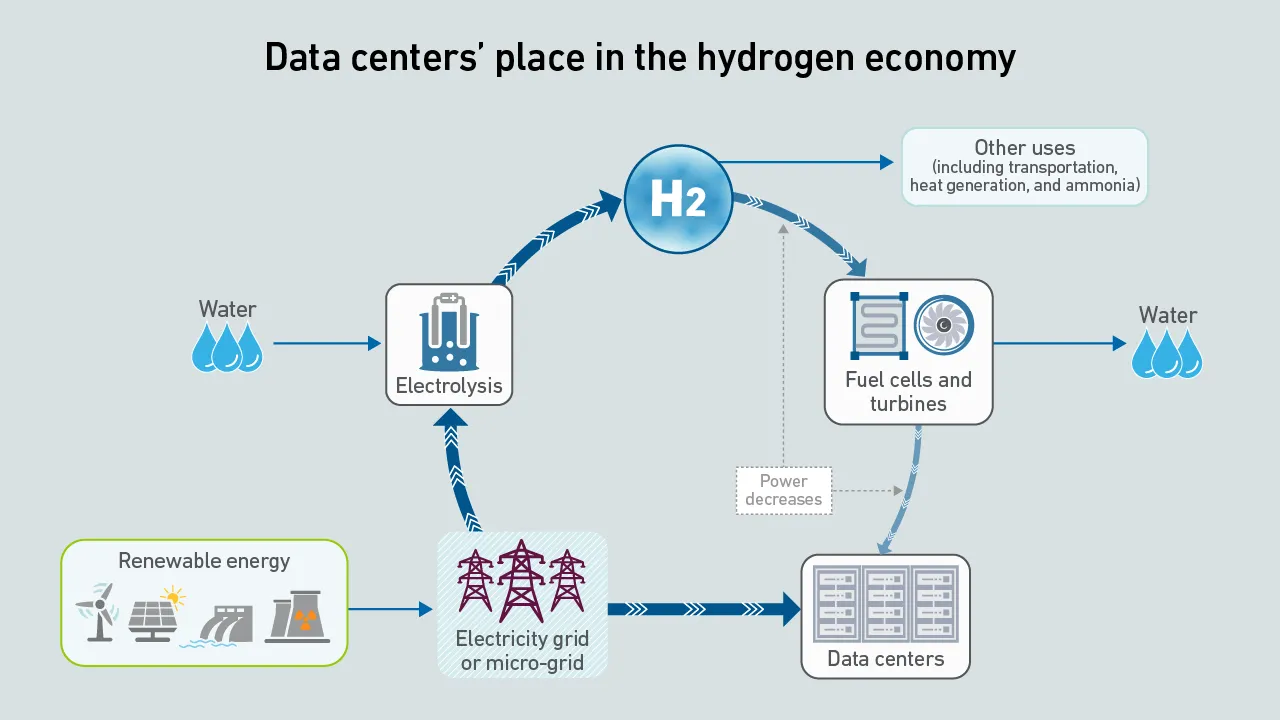
Hydrogen in data centers: an introduction

Hydrogen is a promising energy storage medium that can help decarbonize infrastructure. It is not a great fit for the majority of data centers, and the hydrogen economy is not fully developed.

Uptime Institute Global Data Center Survey 2024

The 14th edition of the Uptime Institute Global Data Center Survey highlights the experiences and strategies of data center owners and operators in the areas of resiliency, sustainability, efficiency, staffing, cloud and AI.

Europe taxes waste heat recovery: can data centers make it work?

According to a recent court ruling, European organizations are required to charge value added tax (VAT) on waste heat that they give away for free. This calls into question the economics of waste heat reuse.

European legislation prompts greater environmental action

In response to stronger environmental legislation, data center operators in European countries are making greater investments in data center efficiency - as well as increasing their reporting.

Ignore Li-ion fire risks at your peril

Li-ion batteries have many benefits but may have been adopted without sufficient risk analysis. Following serious data center fires, operators should be aware of the risk of damage, potential regulations and the costs of safety mitigation.