UII UPDATE 540 | OCTOBER 2026
Intelligence Update
Neoclouds in 2026: the pressure builds

In October 2025, Uptime Intelligence described how a new breed of cloud providers, known as neoclouds, were absorbing risk in the burgeoning AI ecosystem (see Neoclouds: AI's shock absorbers).
Neoclouds are the broker-dealers of AI infrastructure: they match GPU supply to demand and are responsible for the brunt of GPU capacity planning. The report argued that if demand should fall, neoclouds and their investors — not hyperscalers, chip vendors or colocation providers — would be left holding most of the loss-generating assets.
One year on, the demand shock has not arrived. CoreWeave, one of the largest neoclouds, saw its revenue backlog grow from $55.6 billion at the end of Q3 2025 to approximately $104 billion by June 2026. Rental markets showed strength too: SemiAnalysis's index of 1-year H100 rental prices rose almost 40%, from $1.70 to $2.35 per GPU-hour between October 2025 and March 2026. The neoclouds' ability to absorb supply and demand imbalances remains untested.
However, the risk is no longer concentrated solely in neoclouds. Nvidia has agreed to cover shortfalls for some neoclouds if demand does not materialize (in an arrangement known as a "backstop"). At the same time, lenders are funding the data center build-out at scale, and customers now commit through prepayment contracts. These arrangements reduce individual neoclouds' near-term exposure but do not eliminate ecosystem risk: they redistribute it among parties whose obligations are overlapping, and sometimes dependent on the same underlying customers and assets. Neoclouds remain the first line of defense against a demand shock, but a failure could now propagate more widely.
A complex system
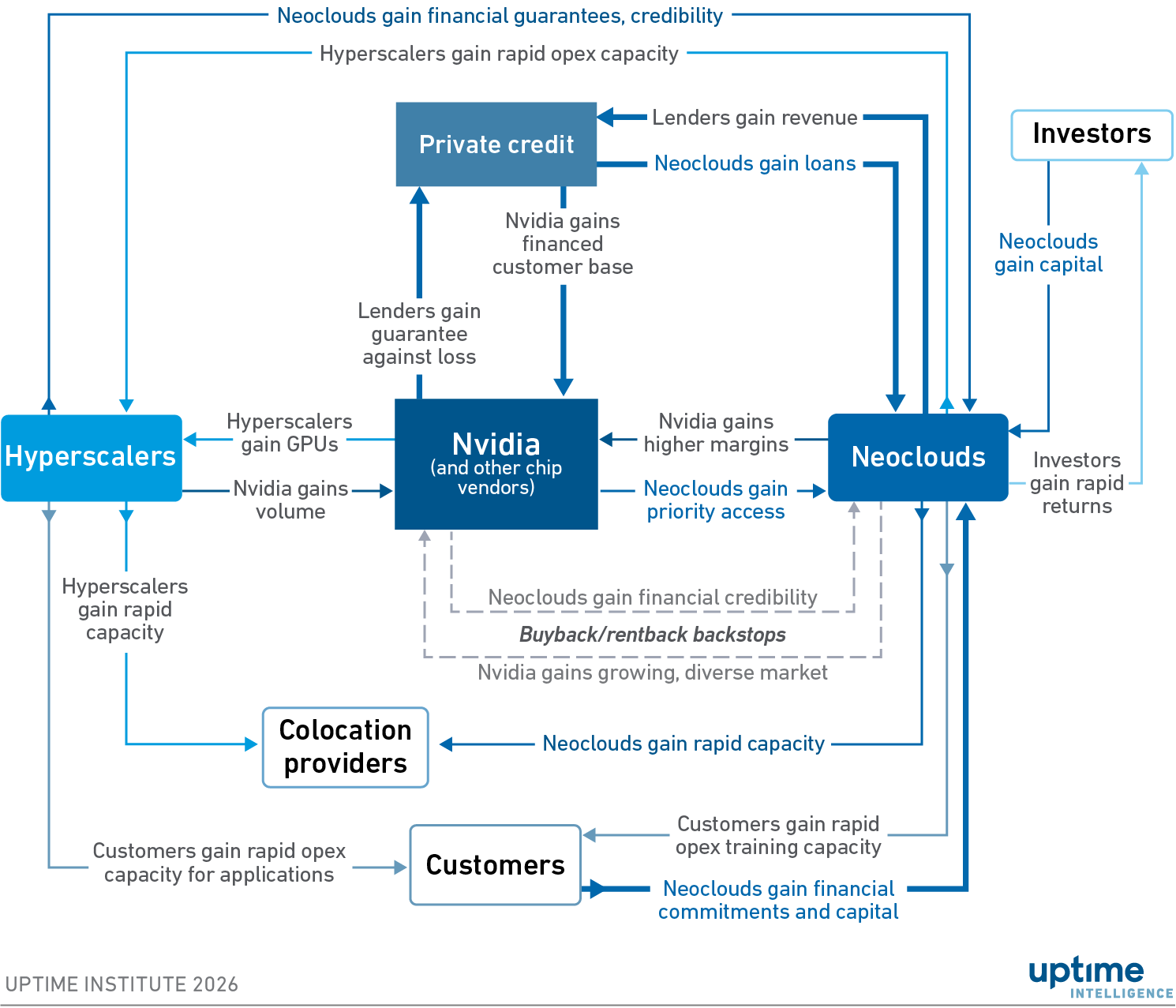
In 2025, a previous version of Figure 1 (see Neoclouds: AI's shock absorbers) showed how each party in the GPU ecosystem benefits from neoclouds. Hyperscalers gain rapid capacity they can pay for as operating expenditure. Nvidia gains volume, higher margins and a broader customer base. Neoclouds gain priority access to GPUs, financial guarantees and capital from investors. Hyperscalers and customers gain fast access to capacity. And colocation providers gain new revenue streams.
The updated Figure 1 keeps these relationships and adds several more, shown in thicker outlines. First, lenders have become a major source of neocloud funding through GPU-backed and other secured loans, with Nvidia offering to backstop some deals. Second, customers are now bound to neoclouds through commitment contracts and prepayments, giving neoclouds more predictable revenue and upfront cash. Nvidia's original buyback agreements have also transformed into a rent-back model offered to other neoclouds, although some of these deals have since been paused. Each of these changes is discussed below (see Others share the risk).
Figure 1 Relationships in GPU ecosystem (thicker lines: relationships added since 2025)
Neoclouds shoulder the risk
The neoclouds' role as shock absorbers has grown in scale and importance over the past year. Neoclouds now hold far more capacity, debt and contracted demand than they did in 2025.
For example, CoreWeave reported principal debt of $35.6 billion as of June 30, 2026. It expects $35-39 billion of capital spending in 2026.
Hyperscalers are also placing more of their capacity and financing in neocloud hands. Microsoft's 5-year deal with Nebius is worth about $17.4 billion, potentially rising to $19.4 billion with additional services or capacity. But outsourcing capacity does not mean outsourcing all the risk: hyperscalers with long-term payment commitments still bear some utilization risk during the contract (see Where to deploy AI training: a guide to the economics), while the neocloud retains financing, delivery and residual-value risk.
Contracts also bring execution risk. Backlog becomes revenue only as capacity is delivered, and delays in construction, grid connections or GPU deployment can defer revenue without deferring financing costs. In November 2025, CoreWeave cut its 2025 revenue guidance after a third-party data center developer fell behind schedule, although the company stated the delay did not affect backlog contract value.
The overall result from these developments is that far more GPU capacity, and the debt that funds it, now sits on neocloud balance sheets. Customer commitments offer protection, but neoclouds remain exposed when those commitments expire.
Others share the risk
Although more money is flowing into neoclouds than ever before, the parties supporting them are taking on their own risks.
Nvidia nurtures
As discussed in the previously referenced report, Nvidia has a substantial interest in nurturing the AI ecosystem to grow. More partners should drive more customers, which should translate into greater volume of sales. For sustained growth, however, Nvidia needs to remove a major barrier to adoption: access to capital.
Through 2026, Nvidia has announced new flexible purchase contracts and partnerships. These arrangements pass some risk exposure from the customer to Nvidia, thereby allowing purchasers to more readily gain access to capital to buy expensive AI clusters. However, if demand falls, capacity backstops and guarantees could shift some losses to Nvidia.
- New flexible purchasing. In July 2026, Nvidia extended the approach originally taken with CoreWeave to other neoclouds through a revenue-sharing and credit-support model. Under a 2025 agreement, Nvidia must purchase residual unsold capacity from CoreWeave through April 2032, subject to delivery and availability requirements and contractual termination conditions.
In the new model adopted by other neoclouds including Firmus and SharonAI, Nvidia agrees to rent back unused GPUs at a fixed rate and, in return, earns a share of the cloud revenue on the supported capacity. In late August, however, Nvidia reportedly paused some of these deals over concerns about potential antitrust scrutiny. Nvidia says the model remains in place and is evolving.
Nvidia's support now extends beyond GPU capacity to the data centers housing it. In August 2026, the company disclosed residual value guarantees with SB Energy covering leases for approximately 4.25 GW of IT capacity in Ohio (US), which OpenAI will occupy under 20-year leases. If the facilities cannot be re-leased or sold for a guaranteed minimum value, Nvidia covers the shortfall, capped at $105 billion. The scale is important: before this deal, Nvidia's maximum exposure under similar guarantees for other AI cloud operators was $3.5 billion. - New financial partnerships. In August, Nvidia announced partnerships with Apollo, BlackRock, Blackstone, Brookfield, Goldman Sachs and KKR aimed at mobilizing more than $500 billion in third-party capital for AI infrastructure over time. CEO Jensen Huang said Nvidia has the option to backstop up to $125 billion, or 25% of potential deals. The partnerships remain subject to final agreements, and Nvidia has not disclosed financial terms or a timetable — this is potential funding, not capital already deployed.
- Insurance. Nvidia has held early-stage talks with insurers about covering loans to neoclouds that pledge Nvidia chips as collateral, protecting lenders if a borrower defaults and the resold chips fetch less than the debt. However, no Nvidia-backed policy has been announced yet. A specialist market is also emerging: American Compute, for example, offers residual value insurance for Nvidia GPUs, aimed at equipment finance companies with operating leases. If these products scale, insurers and their investors would form another risk absorption layer behind the neoclouds.
Customers commit
Customers are also more deeply committed than a year ago. CoreWeave says its committed contracts are take-or-pay, requiring customers to pay whether or not they use the capacity. These contracts accounted for 98% of Q2 2026 revenue. Meanwhile, roughly 70% of the deals Nebius closed in Q2 included customer prepayments, which it expects to provide more than $9 billion in upfront funding in 2026, covering 50-60% of associated capital expenditure.
In 2025, Uptime Intelligence assumed customers (including hyperscalers) could reduce their exposure as leases expired. Today, longer-term commitments mean some would continue paying for capacity even if their requirements fell.
Neoclouds often experience limited customer diversity. CoreWeave's three largest customers accounted for 72% of its Q2 2026 revenue. A downturn could weaken a neocloud, its anchor customer and the lenders financing its assets at the same time.
Lenders lend
Lenders now carry more of the costs of the AI build-out than a year ago. CoreWeave's debt is one example, but other neoclouds are borrowing too, from banks and private credit lines. Lambda closed a $1 billion credit facility in May 2026, up from $275 million the previous August, and priced a separate $926 million secured term loan in August 2026. Nebius said it expected to finance its Microsoft deal partly through debt secured against the contract, with terms reflecting Microsoft's credit quality.
Where loans are secured against GPUs, lenders are exposed to their value over time. If demand falls or newer hardware erodes the resale value of older GPUs, the backing behind these loans could shrink just as neoclouds need to refinance. Nvidia's proposed financing schemes could draw even more institutional capital into the build-out.
In 2025, Uptime described neoclouds as funded by enthusiastic lenders. Those lenders are now among the parties most likely to share the losses if the shock absorbers fail.
This risk is not limited to neoclouds. In September 2026, Oracle sent a force majeure notice to the developer of its Project Jupiter campus in New Mexico (US), citing potential power delays. The notice allows Oracle to defer full rent payments if the site misses its 2028 start date — potentially shifting part of the delay risk onto the developer and its lenders.
The Uptime Intelligence View
Neoclouds continue to act as the shock absorbers of AI infrastructure demand risk. Over the past year, however, chip vendors, customers and lenders have taken on risks of their own. Nvidia is providing capacity and financing support, customers are making longer-term commitments and lenders are extending more credit. Demand for AI infrastructure has not fallen and appears strong in the near-term. Sustained demand over the long term, however, is not assured: organizations are concerned about spiraling costs and the lack of clear returns on AI investment. If organizations and consumers do not fully embrace AI, neoclouds will be the most exposed. If neoclouds falter, the wider ecosystem will be at risk too. How far these losses could spread will depend on contract terms, customer creditworthiness and the second-hand value of GPU assets.
About the Author

Dr. Owen Rogers
Dr. Owen Rogers is Uptime Institute’s Senior Research Director of Cloud Computing. Dr. Rogers has been analyzing the economics of cloud for over a decade as a chartered engineer, product manager and industry analyst. Rogers covers all areas of cloud, including AI, FinOps, sustainability, hybrid infrastructure and quantum computing.
orogers@uptimeinstitute.com