UII UPDATE 547 | OCTOBER 2026
Intelligence Update
Data center energy growth: substantial but constrained

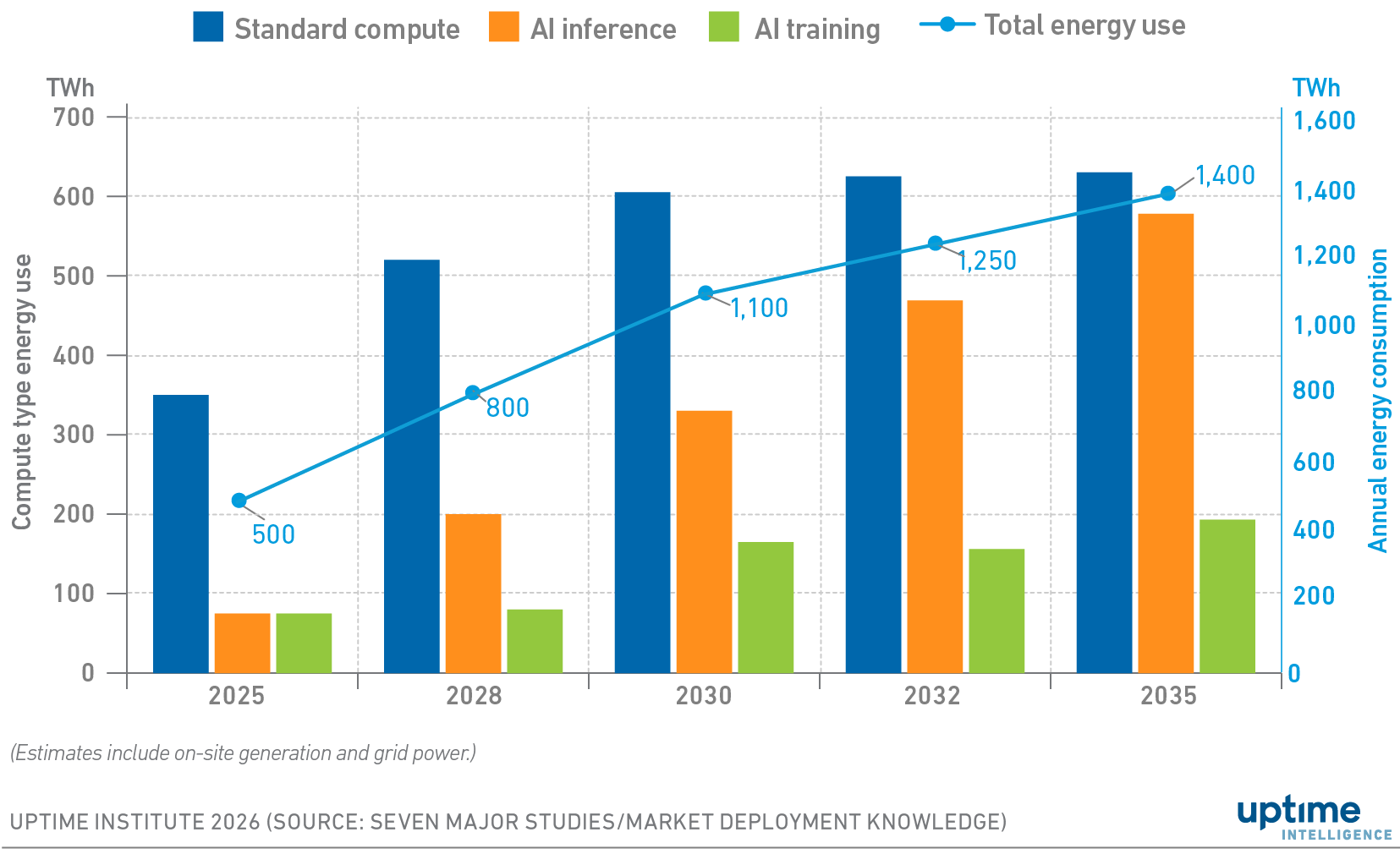
Uptime Intelligence projects global data center energy consumption to rise 2.2-fold from 2025 to 2030 (from 500 TWh to 1,100 TWh) and 2.8-fold by 2035 (1,400 TWh, see Figure 1). This growth will rapidly expand and reshape the global data center portfolio, with a mix of large campuses ranging from 500 MW to 5,000 MW or more (see Giant data centers: build-out proposals for 2026 track 2025 levels) alongside numerous smaller edge data centers of 10-100 MW in urban and metropolitan areas. Growth projections beyond 2030 carry a high degree of uncertainty because IT infrastructure configurations, particularly for inference, will rapidly change as operators search for a sustainable, economically viable AI inference business models.
Figure 1 Projected data center global energy consumption 2025-2035
Eight global data center energy use projections published from July 2025 to July 2026 (Figure 2), along with several US-specific projections, were assessed to generate the Uptime energy use projection. Because the US is projected to account for 40-50% of data center energy consumption through 2030 (and likely through 2035), the US projections were used to validate the global projections.
Figure 2 Published data center energy use projections 2025-2035
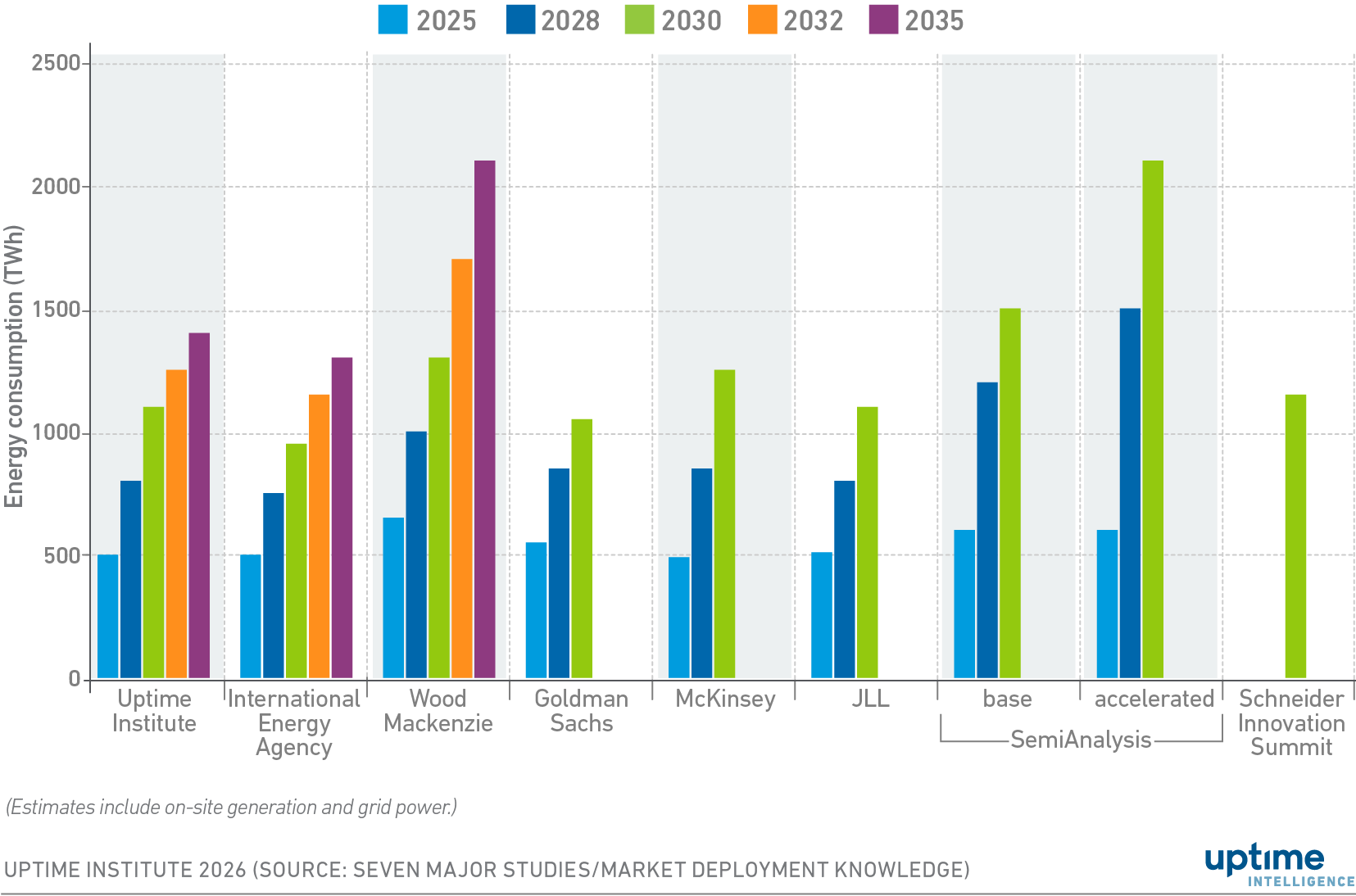
The SemiAnalysis (SA) and Wood Mackenzie (WM) projections were the most aggressive. From a 2025 baseline of 500 TWh, WM projected 2.6-fold growth in global data center energy consumption by 2030, while SA projected 3.0-fold growth in its base case and 4.2-fold growth in its accelerated case. WM projected 4.2-fold growth by 2035. The Uptime Institute energy consumption projections are more conservative and fall into the same range as the remaining five projections, with a slightly more aggressive outlook than the often-cited International Energy Agency projection.
The buildout of announced projects faces a range of constraints that will mitigate and depress the growth rate of global data center energy consumption:
- Announced capacity likely exceeds demand.
- Energy systems and supply chains cannot support the projected growth.
- AI modeling and inference infrastructure are evolving.
- The continued growth of less energy-intensive standard compute infrastructure.
Announced capacity likely exceeds demand
AI's market opportunity will be substantial and will expand as companies develop and deliver inference-based applications and agents. However, the ultimate size and shape of the AI market is very much a work in progress. Each company competing for AI business (there are more than 20 major players) expects to capture 20- 30% of the market. However, only a few companies will become dominant, with the others leaving the market, being acquired or becoming smaller niche players.
Each company is building capacity to capture its expected market share (the individual circles in Figure 3), but the overall economically viable AI market (the large, outer circle in Figure 3) will not support the aggregated planned capacity. Current AI revenue projections fall far short of the cash flow needed to service the $3-5 trillion dollars of projected investment planned by all the market participants over the next 5 years.
Figure 3 Economically viable AI capacity and organizational market share
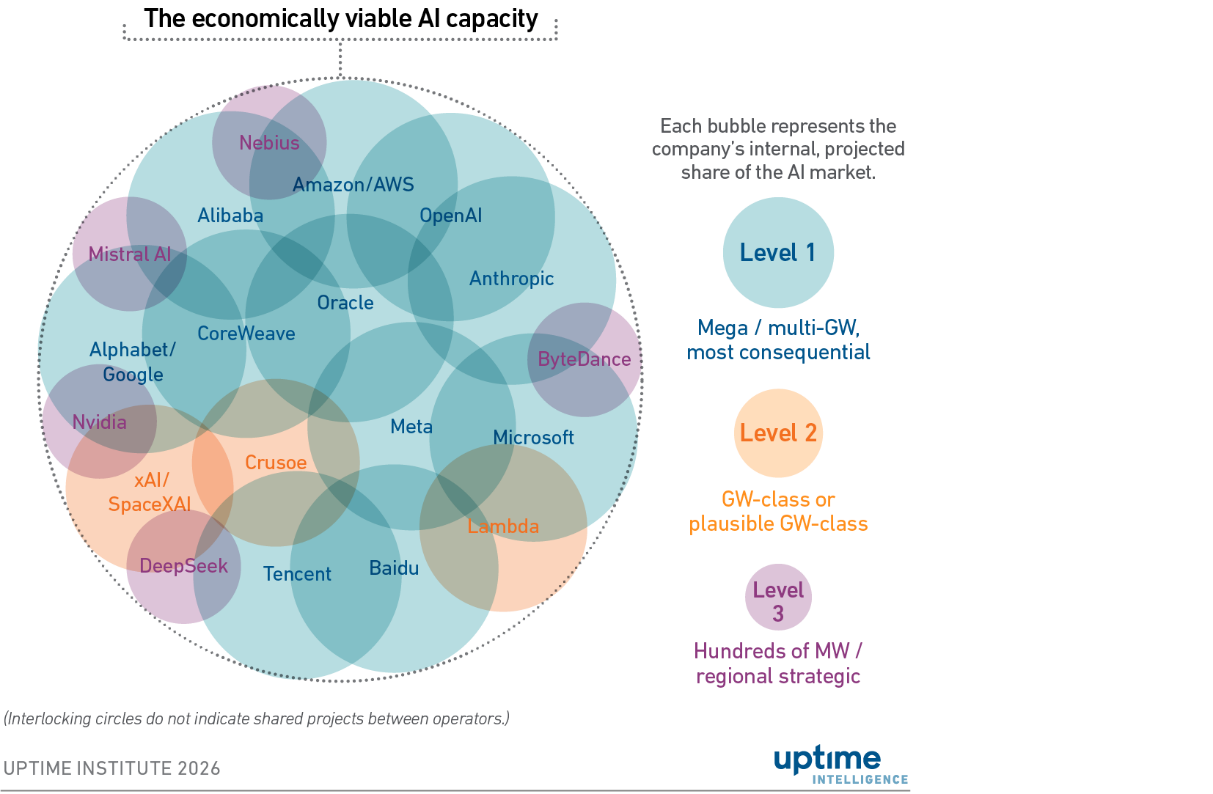
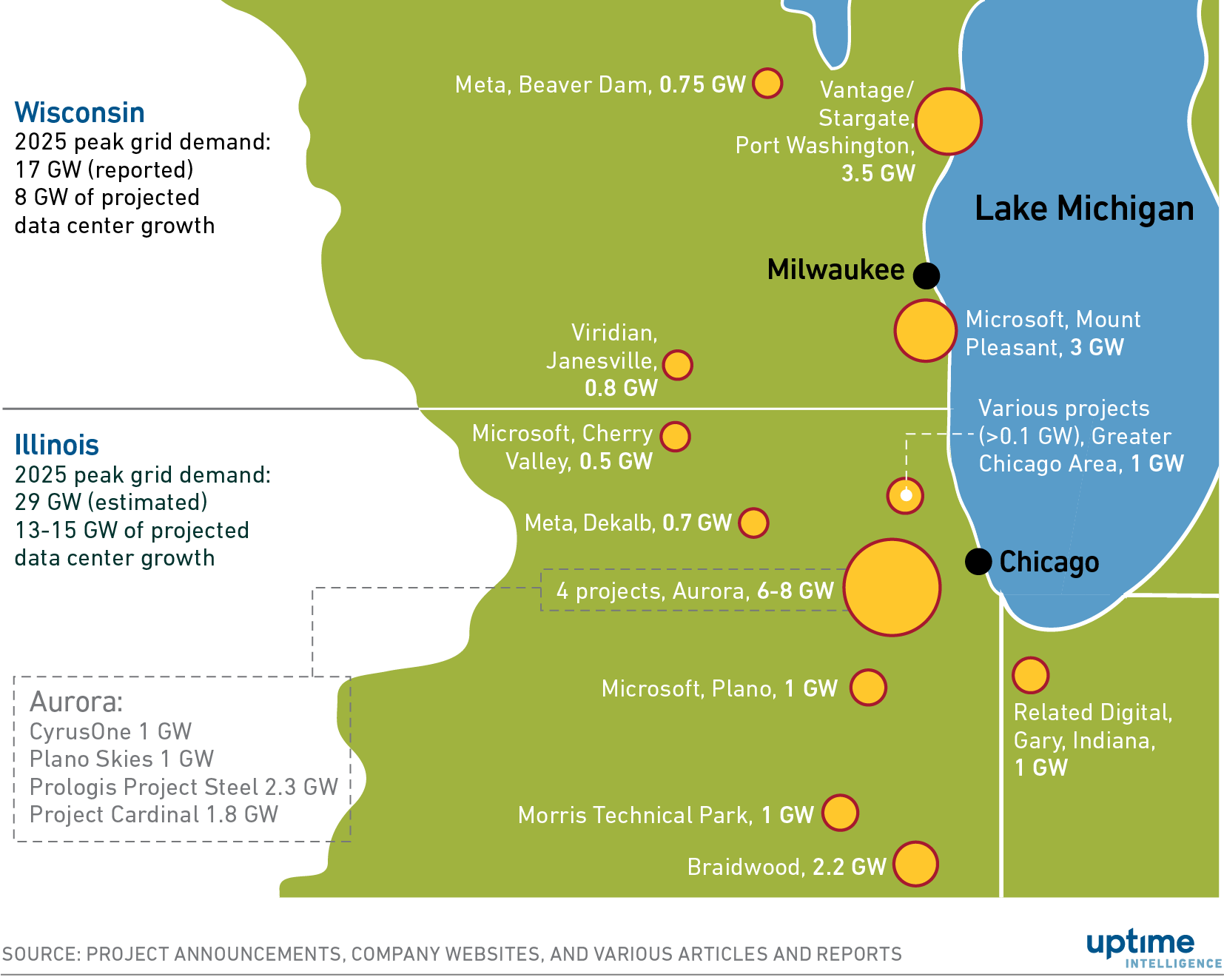
Evidence of overbuilding is already appearing. SpaceXAI has announced a lease agreement with Anthropic for existing capacity, while Meta is pursuing a similar agreement, suggesting their internal capacity exceeds their AI development and operational needs. Many projects have been canceled because they could not attract a tenant, finalize financing, secure critical facilities and power infrastructure, obtain required permits and/or manage public opposition. Announced projects are geographically clustered, creating unmanageable concentrations of energy demand and supply-chain stress (see Figure 4) that will likely preclude construction of 50% or more of the announced capacity (see Giant data centers: build-out proposals for 2026 track 2025 levels).
Figure 4 Announced Southeast Wisconsin and Chicago Metropolitan projects
Power systems lack capacity
The concentration of large data center projects complicates the availability of bulk and standby power generation, transmission system, and data center electrical and cooling system capacity. The number of systems required and the extended timeline for equipment acquisition and facility construction make it impossible to build all announced facilities and their supporting infrastructure. The Southeast Wisconsin/Chicago metropolitan example is one of two dozen existing or emerging data center corridors in the US, such as Ohio, Dallas-Fort Worth (Texas) and Northern Virginia. Similar corridors exist or are emerging around the globe, including Beijing-Hebie in northern China, the London/M4 corridor, Singapore-Johor and Dubai/Abu Dhabi. Power constraints limit capacity growth and are factored into Uptime's energy consumption projection.
Models are evolving
Many companies worldwide develop general-purpose, specialized, and regional-language models, using a mix of proprietary and open-weight approaches. Individual developers and entities, in turn, adapt and apply these models on internal data and work processes and, where justified, undertake further domain training. These entity-level efforts will use more compact infrastructure with hundreds of GPUs, rather than thousands or tens of thousands.
The use of small models will grow, as enterprises and governments adapt and apply models to their specific needs. The convergence to a limited number of dominant large language models and the propagation of small, entity-specific models will limit AI modelling energy consumption to 10-15% of total data center consumption.
Further energy efficiency gains will be realized through the introduction of "model concierge" or orchestration services. Hyperscalers and neoclouds are offering companies an AI inference management and facilitation layer that assesses a given query/task and selects the lowest-cost model expected to meet the task's quality requirements, subject to constraints such as response time, security and data location.
Although energy consumption will increase as models become more complex, several factors will moderate this growth. These include the likely predominance of a limited, select set of large language models, the spread of smaller, entity-specific models, and the ability to assign the most efficient model for a given task. These mitigating factors will mean that model energy demand increases more slowly than AI inference.
Inference infrastructure is evolving
AI's success depends on translating model capabilities into economically valuable applications and agents, including knowledge-query tools, personal assistants, coding and customer-facing agents, as well as specialized professional and business applications. These workloads run on inference infrastructure, currently dominated by GPUs, including repurposed training systems. High hardware costs and energy consumption are driving the development of alternative inference infrastructures based on standard compute, ASICs (including Groq, d-Matrix, Cerebras, Microsoft's Maia, AWS' Inferentia and Google's TPU 8i) and hybrid GPU systems designed to maximize work delivered per unit of energy consumed. Training and inference infrastructure will increasingly diverge as inference shifts towards efficient, purpose-designed ASIC systems.
Improving inference efficiency and continuously reducing cost per token will be critical to achieving the adoption and revenue needed to cover capacity investments and meet investor expectations. Inference systems are evolving rapidly: cooling and power requirements of these new systems, along with their improvement in delivered performance per watt, will determine the number, type and size of data centers needed to support AI growth. Uptime Intelligence projects inference performance-per-watt improvements will be comparable to those achieved by standard compute infrastructure from 2010 to 2020, and will moderate growth in facility capacity and energy consumption over the next decade.
Standard compute contributes to growth
Standard compute systems are projected to contribute 45% of growth up to 2030 and 35% from 2030 to 2035. BloombergNEF recently estimated that 65% of Microsoft's infrastructure will be standard compute systems in 2032, while Uptime estimates that, globally, standard compute will represent 50%. This infrastructure will have lower rack energy densities and lower energy demand per unit of floor area than an AI inference/training data center, slowing the rate of energy growth.
Observations
Uptime Intelligence projects global data center electricity consumption to more than double by 2030, reaching 1,100 TWh, and then rise to 1,400 TWh by 2035. This expansion will be driven by 50% or less of the announced large data center projects and will incorporate a significant cohort of smaller metropolitan facilities, creating a widely distributed, diverse infrastructure portfolio.
The projected growth in power consumption is not AI-specific; it will be distributed across standard compute, AI inference and AI training infrastructure. Standard compute and AI inference are likely to account for 40-50% of installed capacity each, with AI training accounting for 10-15%. However, AI data center development and buildout are 3 years into a long revolution: expect more waves of change over the next 10 years, as facility and IT infrastructures are reimagined, redesigned and optimized to increase system efficiency and improve the industry's economics.
The Uptime Intelligence View
Data center energy growth will reflect more than the expansion of large AI training systems. Standard compute remains a major source of additional demand, while AI's commercial development and growth rate depend on deploying and using inference applications and agents. Smaller, task-specific models, model orchestration gatekeepers, and specialized inference hardware that evolve toward task-specific capabilities and higher efficiency will improve work performed per unit of energy and the economic viability of AI infrastructure.
These efficiency gains will moderate, rather than remove, the need for new data center space and increased energy consumption. Power-system limitations, supply-chain constraints and uncertain commercial returns will further separate announced projects from completed facilities. Uptime Intelligence therefore expects substantial but constrained energy growth. Projections beyond 2030 are particularly sensitive to the evolution of inference infrastructure efficiency and the scale of economically sustainable AI adoption.
About the Author

Jay Dietrich
Jay is the Research Director of Sustainability at Uptime Institute. Dietrich looks beyond the hype to analyze the transformations required in energy and IT systems, data centers and software management systems, and intra-organizational collaboration, both within and between companies, to deliver sustainable data center operations.
[email protected]