Intelligence Update
Germany confronts reality on data center efficiency

Germany's Federal Cabinet has approved an amendment to the Energy Efficiency Act (EnEfG) that would ease regulatory requirements for data center operators. The proposed changes remain subject to revision by the German Parliament (Bundestag) and Federal Council (Bundesrat). Without the amendments, the EnEfG will constrain investment in Germany by developers and operators.
The German Federal Government (Bundesregierung) is also working on other measures affecting the legal and social role of data centers, including new tax rules, proposals to reduce grid connection times, and an emerging strategic plan to double overall data center capacity and increase AI computing capacity fourfold by 2030.
Refining requirements
The EU introduced data center reporting requirements to its Energy Efficiency Directive (EED) in 2023. Germany was the first to respond, passing its Energy Efficiency Act (EnEfG) almost immediately, 2 years before it was required to transpose the EED into German law.
The EnEfG went beyond the EED requirements for data center reporting, implementing more stringent reporting and setting aggressive PUE thresholds and heat use requirements despite the lack of similar thresholds in the EED. The German Datacenter Association (GDA) criticized this "gold plating" of the EED.
The German Federal Cabinet has proposed rolling back some parts of the EnEfG that go beyond the EED, in an amendment designed to complete the formal transposition of the EED. The bill is subject to amendment and approval by the German Parliament and German Federal Council. Final approval is expected in December 2026.
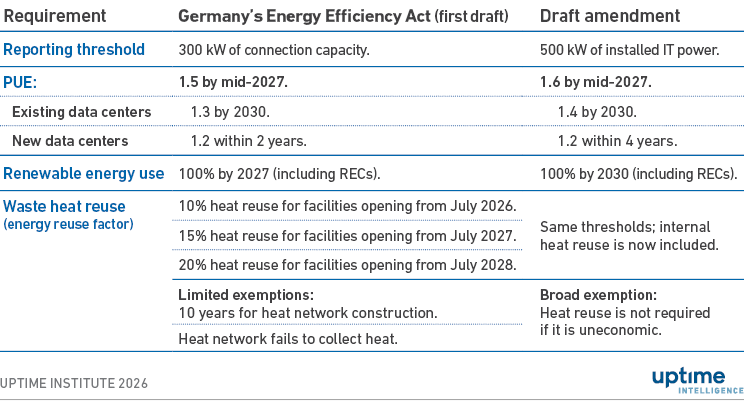
For data centers, the amendment bill modifies four conditions of the original EnEfG (Table 1). It changes the reporting threshold from 300 kW of non-redundant nominal total connection capacity power to 500 kW of installed IT power, which aligns more closely with the EED and will take many small facilities out of scope. The shift from connection capacity to installed IT power means this provision is likely to lift more facilities out of scope than a simple increase in capacity.
Operators must reassess every facility, as the new criterion of installed IT power may create ambiguity: a lightly loaded data center with more than 500 kW of installed IT capacity might be in scope, despite its active IT load being less than 500 kW. A large but partially occupied shell might not be required to report until its installed IT reaches the threshold.
The amendment still sets PUE limits (not required by EED) but raises them for existing data centers from 1.5 to 1.6 by mid-2027, and from 1.3 to 1.4 by 2030. A proposal to raise the new-build PUE from 1.2 to 1.3 was not retained in the government draft. This was a missed opportunity: 1.2 is too strict, especially since facilities will likely need to use more water to meet it. Instead, new facilities will be given 4 years, rather than 2, to achieve the strict PUE of 1.2.
The proposed amendment applies economic reality to the EnEfG's original mandate to enforce all industries to harness unavoidable waste heat. It reduces reporting demands and introduces a cost-benefit analysis requirement.
For data centers, the existing EnEfG requires new facilities to install heat export equipment; to offer heat to district networks; and to achieve 10% reuse from July 2026, 15% from July 2027, and 20% from July 2028. Under the amendment bill, these limits would remain, but would be required only if the cost-benefit analysis finds a technically and economically feasible connection to an existing or planned heat network. Rather than installing heat export equipment, operators must merely reserve space for a heat-transfer station if there is no economic opportunity to export waste heat. Where facilities are required to reuse heat, the amendment will allow them to include heat used within the facility in energy reuse factor (ERF) calculations.
The amendment bill also increases cross-industry thresholds for mandatory energy audits and energy management systems, but data centers are energy intensive, so these are unlikely to take facilities out of scope.
One new requirement in the bill is that any organization/legal entity making an investment above €100 million must assess whether a more energy-efficient alternative exists. The impact of this requirement on data centers is not yet determined, but the cost-benefit analyses must be made public.
Table1 Amendments proposed for Germany's Energy Efficiency Act (EnEfG)
Implications
The amendment will give Germany a more predictable planning environment, which focuses on environmental performance improvements that are economically achievable — particularly for enterprise and retail colocation data centers with a heterogeneous IT infrastructure.
Data reporting theshold
The increased threshold (and the shift from facility power to IT power) will exempt many small, inconsequential facilities from reporting, PUE targets and other requirements. Analysis of the EED data published so far shows that facilities below 500 kW of IT load contribute less than 1% of data center power demand across Europe (see Coverage and quality concerns persist in EU's EED data). Therefore, data from these smaller facilities contributes little to improving energy efficiency.
PUE minimum performance threshold
Although new facilities have more time to achieve a low PUE, the technology associations Bitkom and GDA have warned that the PUE of 1.2 may be unrealistic in many cases. GDA notes that PUE depends on IT load and will rise if IT load is lower, even if the facility itself has not become less efficient. This poses a particular risk for colocation operators that do not control their customers' IT loads. The amendment did not adopt two GDA proposals: keeping the ambitious PUE figure of 1.2 for fully loaded facilities, but applying load-dependent PUE limits for 25%, 50%, 75% of design IT load; or easing the PUE for new facilities to 1.3. GDA also warned of unintended trade-off between water use and PUE.
Operators should re-examine their existing facilities in light of the looser PUE demands that will apply if the bill passes. Older colocation and enterprise data centers that currently face write-downs, or expensive retrofits to meet a PUE of 1.5 by 2027 (or 1.3 by 2030), may now have a longer viable life in their current state if they meet PUEs of 1.6 and 1.4, respectively. Smaller facilities below 500 kW can now be assessed on their own merits rather than on their ability to meet EnEfG targets.
Heat reuse requirements
Under the amendment, heat reuse remains an aspiration, but the bill acknowledges that the data center operator cannot create heat demand that does not exist, so it will not always be viable. Operators must carry out a feasibility study but are not required to proceed or to install heat export equipment if heat reuse is uneconomic. Facilities that are required to meet a heat reuse quota will be able to count any internal use against that target.
The bill's heat reuse requirements should eliminate the cost of providing heat export equipment that may not be used. It will make exemptions easier to prove, although operators must still pay for a feasibility study.
Renewable energy use reporting
The bill proposes to allow operators 3 additional years (until 2030) to achieve 100% market-based renewable energy use. The timing of the amendment is important: if it is not in force by 1 January 2027, the requirement to source 100% renewable energy will apply from that date.
The amendment missed some opportunities. It could have broadened the requirement from renewable to low-carbon electricity, which would have acknowledged the emissions reduction achieved by operators using nuclear electricity imported from France. It could also have introduced a location-based requirement, set at an appropriate level to encourage local low-carbon investment.
Other measures
Similarly to other nations with a data center industry, Germany has to balance national priorities to develop data centers (particularly those for AI) against strong local opposition on social and environmental grounds.
Recent opposition has caused projects to be delayed, canceled or altered:
- EdgeConneX suspended plans for a 170 MW on-site gas power plant in Maintal-Dörnigheim after local protests, leaving a €1 billion data center project in doubt.
- Vantage Data Centers' revised its plans for a campus near Frankfurt, after feedback from Groß-Gerau City Council in the Rhine-Main region.
- Stack Infrastructure withdrew a proposed €3 billion campus at Babenhausen in the face of stringent council demands.
Making the EnEfG more pragmatic sits alongside other efforts by the German government to promote a data center industry that meets German needs, contributes to society and is compatible with infrastructure developments.
In March 2026, the federal government published a National Data Centre Strategy designed to encourage strategic data centers instead of merely legislating to manage/minimize their environmental impact. The strategy aims to double IT capacity from 3 GW in 2025 to 6 GW by 2030 and to quadruple AI capacity. Separate legislative measures will provide connection reforms, trade tax reform and permitting reform designed to encourage municipalities to approve projects:
- Since April 2026, grid authorities have been able to prioritize project-ready applications (first-ready, first-served). Other reforms will expose available grid capacity and develop standard flexible connection agreements. Flexible connection agreements may give projects earlier access to power in return for limits on how much capacity they can use and when they can use it.
- Trade tax reform, currently before Parliament, would give municipalities a greater share of taxes paid by data center operators. Currently, municipalities bear the land, infrastructure and environmental impacts of data centers, but receive little trade-tax revenue because the share given to them is based on wages paid, and data centers employ few people. The trade tax reform would give municipalities a share of tax revenue from data centers based on a figure combining non-redundant connection capacity (90%) and wages (10%).
- Permitting reform (amendment to the Federal Building Code), currently before Parliament, aims to encourage faster development across Germany by coordinating planning and permitting procedures, identifying suitable sites, and supporting brownfield development. This reform leaves much permitting power in municipal hands and may distribute development beyond the busy Frankfurt region.
Uptime View
Germany has shifted from treating data centers primarily as large energy consumers to recognizing them as strategic infrastructure whose growth must be enabled. The EnEfG amendment, grid-connection reforms, permitting measures and proposed trade-tax changes collectively reduce regulatory and political barriers to development, without abandoning Germany's efficiency objectives.
Operators should not treat these changes as settled. They should reassess whether existing facilities remain within scope and whether relaxed PUE limits change planned retrofit or retirement decisions. New developments should evaluate heat-network availability during site selection and consider whether flexible grid connections could accelerate energization. Until the EnEfG amendment and associated reforms are enacted, projects should maintain compliance plans against current law as well as the proposed regime.
Note: The regulatory analysis provided in this report is the opinion of Uptime Intelligence. Data center operators should validate the interpretations with their legal staff and any relevant regulatory authorities.
About the Author

Peter Judge
Peter is a Senior Research Analyst at Uptime Intelligence. His expertise includes sustainability, energy efficiency, power and cooling in data centers. He has been a technology journalist for 30 years and has specialized in data centers for the past 10 years.
[email protected]