UII UPDATE 550 | NOVEMBER 2026
Intelligence Update
Emerging tech: ammonia for on-site energy storage

EMERGING TECHNOLOGY SERIES
This report is one of a series on emerging and potentially disruptive technologies that may be deployed in digital infrastructure. Here, Uptime Intelligence considers the use of ammonia for on-site energy storage.
Context
Data centers need carbon-free dispatchable power. Grid access is fiercely contested and subject to long delays, so operators are exploring on-site or behind-the-meter power. Natural gas is the leading practical on-site source, while low-carbon options are often non-dispatchable (wind and solar energy), geographically limited (hydrothermal and geothermal), or still in development (small modular reactors).
On-site wind and solar energy can be made dispatchable with large amounts of storage to capture surplus generation for use during periods of low generation. Lithium-ion batteries have some limitations (especially for longer-duration storage) so alternatives are being considered.
Electrolysis can generate hydrogen using surplus generation, which can then be consumed in solid oxide fuel cells (SOFCs) or turbines. However, this is expensive and hydrogen is hard to store. Ammonia, made from hydrogen and nitrogen, can be stored in liquid form and is being developed as a fuel source, particularly for ships
Ammonia synthesized from green hydrogen is an inefficient energy store (less efficient than using hydrogen directly), however, the improved long-term storage could make it a viable option for on-site energy storage.
The technology
Ammonia (NH3) is mostly used in the manufacture of fertilizer, but it can also serve as a versatile fuel for generators and fuel cells alongside methane and hydrogen. Ammonia can be easily liquefied and has a higher volumetric energy density than compressed hydrogen, making it relatively easy to transport and store.
Ammonia is made in the Haber-Bosch process that combines atmospheric nitrogen with hydrogen. Ammonia is labeled "grey" if the hydrogen is cracked from fossil hydrocarbons or "green" if the hydrogen is electrolyzed from water using low-carbon electricity.
A data center could use behind-the-meter wind and solar, scaled to generate surplus energy which is used to make hydrogen by electrolysis (see Emerging tech: low-carbon hydrogen). The hydrogen is then combined with nitrogen using Haber-Bosch or a similar process to make ammonia, which is stored until needed as fuel (synthesis is exothermic, with significant energy lost as heat).
Pure ammonia can be consumed in adapted SOFCs or burnt in turbines, though it does not burn well. Partially cracking the ammonia makes a combustible blend of ammonia, nitrogen and hydrogen, using catalysts such as Ni/Al2O3.
Partial cracking uses less energy than full cracking back to nitrogen and hydrogen, but the overall cycle — electricity to hydrogen, ammonia and back to electricity — is inefficient. Its round-trip efficiency of 15-25% can be improved somewhat if the heat from the synthesis step is captured and reused.
Ammonia technology is still developing. Alternatives to the Haber-Bosch process (e.g., from Ammobia) could synthesize ammonia more efficiently, while there are also rival cracking methods such as one being developed by Amogy and promising new storage options such as AmHyTech's ambient-temperature liquid solution.
Implementations
Ammonia implementations suitable for data center use are tests or prototypes, rather than commercial installations, and focus on ammonia as fuel rather than a full on-site cycle.
In 2026, Amogy, a hydrogen-cracking firm, and German energy company 2G Energy powered a reciprocating engine-generator with hydrogen from Amogy's ammonia reformer. The combined system, branded AMMDrive, can be expanded in phases and will support commercially viable power, given an ammonia supply.
Amogy is building a demonstration ammonia-powered data center on Jurong Island, Singapore's petrochemical hub. Built with Singapore's public-sector Agency for Science, Technology and Research (A*STAR), it is expected to go live in 2027.
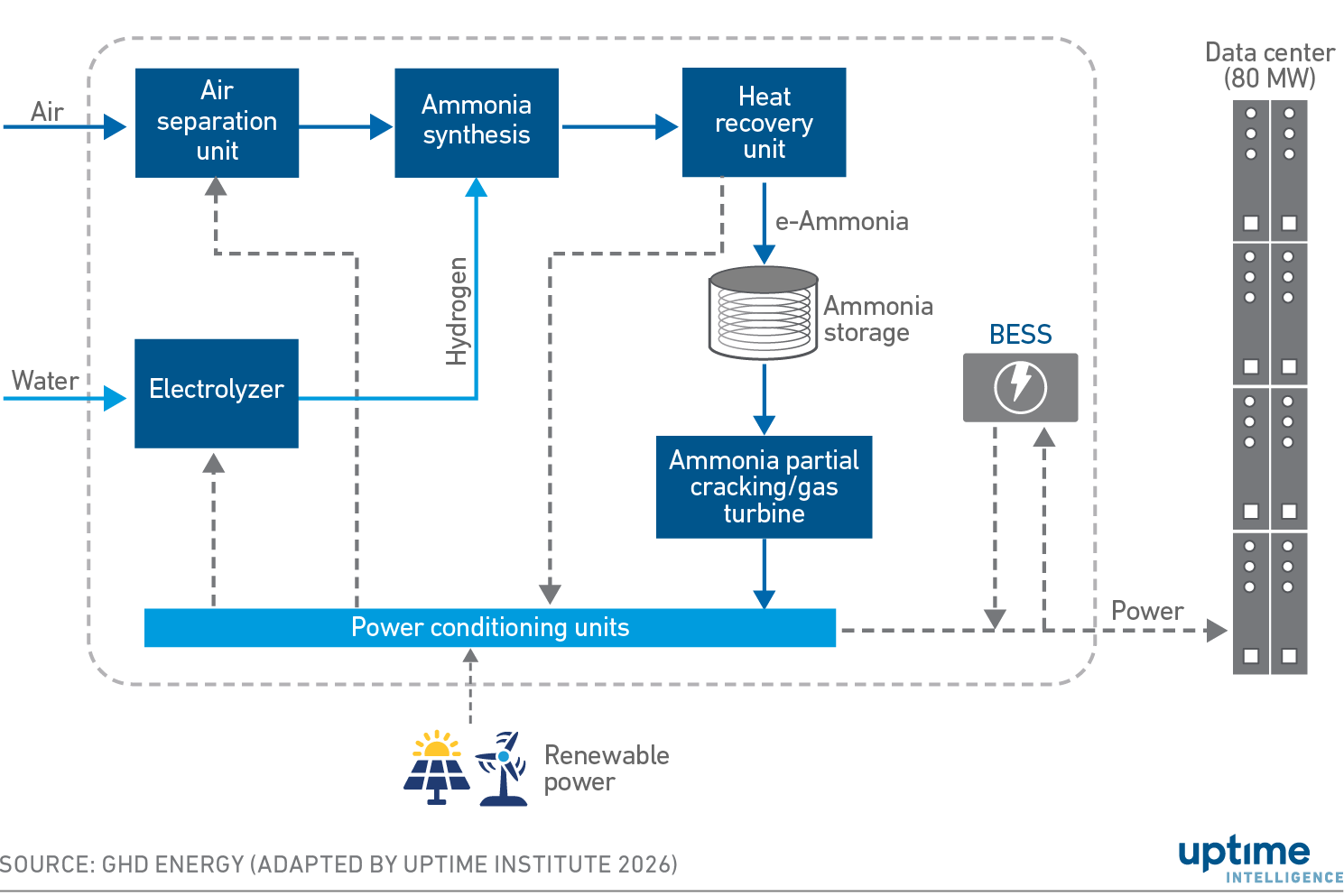
In 2025, engineering firm GHD Energy outlined a design for an 80 MW data center (see Figure 1), with 250 MW of integrated wind and solar, using an on-site ammonia cycle. The design has 140 MW of pressurized proton exchange membrane (PEM) electrolyzers and ammonia-based energy storage. GHD claims a levelized cost of electricity (LCOE) of $128 per MWh (comparable with natural gas), falling to $60 per MWh for larger facilities in the future, although this figure appears to omit some important elements of the overall energy cost.
The analysis accounted for power needed to extract nitrogen in an air separation unit (ASU), as well as round-trip inefficiencies in synthesizing, storing and partially cracking the ammonia. Because ammonia synthesis is exothermic, a heat recovery unit (HRU) can generate steam and power. The system recovers water vapor from flue gases, reducing water demand, and stores surplus electricity in a battery energy storage system (see BESS in data centers: use cases and technologies) or injects it into the grid.
When renewable power is insufficient, the BESS provides up to an hour of power while the ammonia cracking unit and turbine ramp up. If the wind or solar generation fails, ammonia can be trucked to the site.
GHD has not reported any moves to develop such a facility.
Figure 1 On-site ammonia cycle as part of a design for an 80 MW data center
Economics
Grey ammonia, made from natural gas or coal, is readily available at around $300-400 per tonne and is mostly used for fertilizer. Petrochemical hubs — including China (29%), India (9.5%), Russia (9.5%), the US (9.5%) and the Middle East (8.3%) — produce around 200 million tonnes annually.
Green ammonia is scarcer. Costs range from around $700 to $1,400 per tonne because electrolysis is expensive. Government strategies have not reduced this price premium, and green ammonia initiatives are struggling. For example, a 240 MW factory in Norway scheduled to open in 2027, producing 200,000 tonnes of ammonia per year, has been scrapped — the project may be turned into a data center instead.
Low-carbon "blue" ammonia is produced by capturing and storing greenhouse gas emissions but, at around $600 per tonne, is also expensive.
Behind-the-meter implementations as described above do not buy and import ammonia, but on-site production needs electrolyzers and suffers the same high production costs as open-market green hydrogen/ammonia production.
The round-trip efficiency of green ammonia production is 50-65%, and the efficiency of energy production in a turbine generator burning NH3 is 20-35%. The whole process therefore has a low efficiency of 15-25% if some waste heat is harnessed. An on-site ammonia cycle can, however, be commercially viable, GHD argues, if it stores otherwise curtailed capacity, and if long-term storage needs are large enough to give ammonia an advantage over hydrogen.
Ammonia infrastructure, developed for fertilizer production, is reliable and economical. Safety features such as pressure sensors and leak detection are well-established in the grey ammonia industry.
Operating at a relatively small scale, on-site ammonia cycles may be better placed to adopt the new synthesis, cracking and transport systems being developed (see above).
Commercial activity
The leading ammonia-to-power startup Amogy has received $320 million in backing from organizations including Amazon, Aramco Ventures and Mitsubishi Corporation. After commercial pilots in 2026-2027, it expects to scale to tens of megawatts by 2028-2029. It is working with Karpowership, maker of floating power plants, to develop ammonia-powered offshore platforms that combine power generation and data centers.
Mitsubishi Heavy Industries and other organizations have demonstrated multi-fuel turbines burning hydrogen-rich, partially cracked ammonia. Everllence and others are developing pure ammonia-fueled internal combustion engines, including two-stroke engines of 12-68 MW for use in utility-scale power plants.
Pure hydrogen SOFCs are well established, and companies including technology group Wärtsilä are offering pure hydrogen engines. Direct ammonia SOFCs have been successfully demonstrated by organizations including VersaPower in the US, and the Bruno Kessler Foundation in Italy; commercial models are expected in the late 2020s.
Drivers and barriers
Drivers of the technology include:
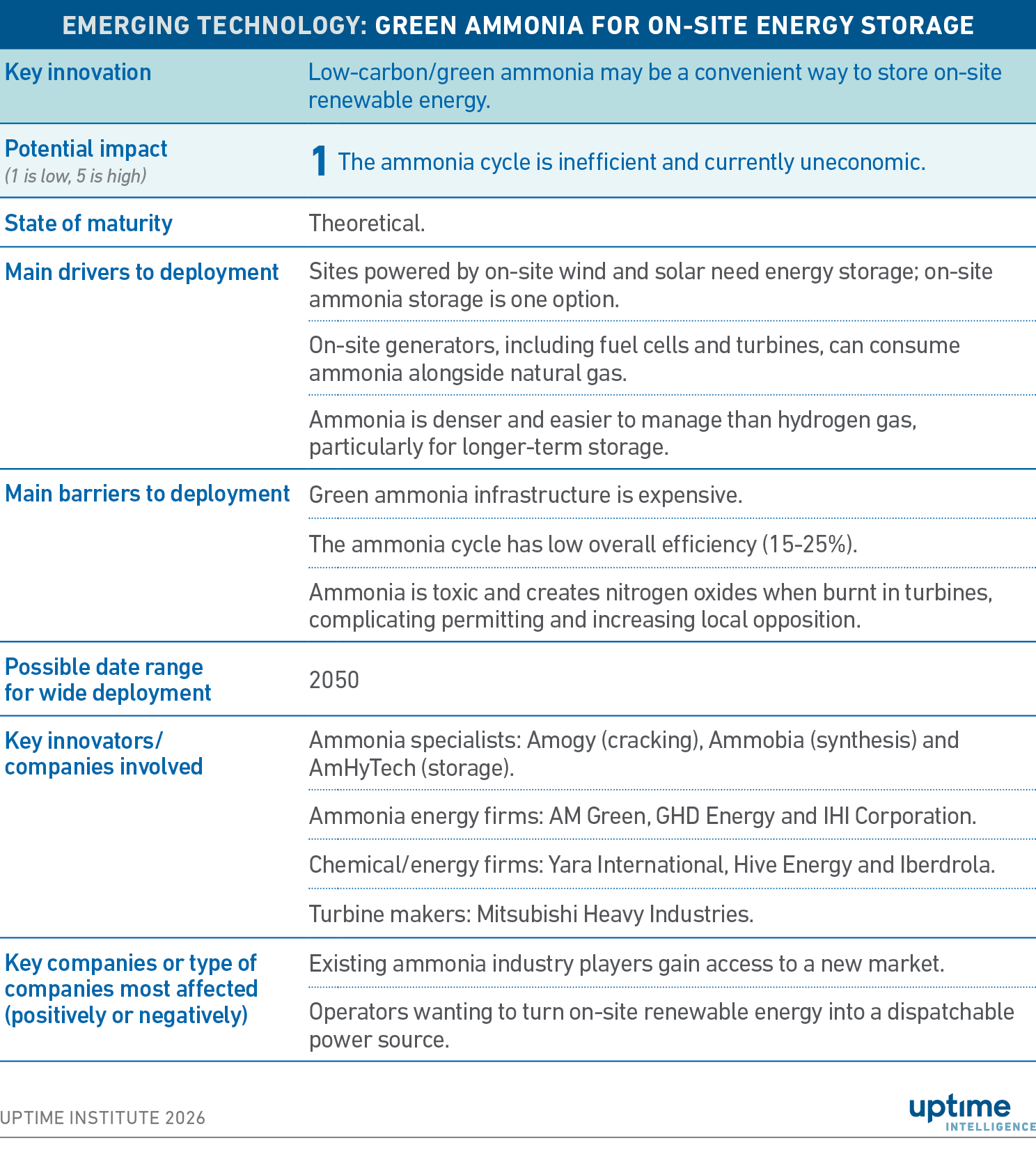
- Sites powered by on-site wind and solar need energy storage to meet decarbonization and grid independence goals. On-site ammonia storage is one option.
- On-site generators, including fuel cells and turbines, can consume ammonia alongside natural gas, which could potentially displace some natural gas use.
- Ammonia is denser and easier to manage than hydrogen gas, particularly for longer-term storage. Ammonia handling and storage are already well developed.
- Water demand is low due to recovery of water in flue gas.
Barriers include:
- Green ammonia infrastructure is expensive and will remain so, as its price is tied to the green hydrogen economy.
- The ammonia cycle has very low overall efficiency (15-25%).
- Ammonia is toxic and creates nitrogen oxides when burnt in turbines, complicating permitting and increasing local opposition.
The Uptime Intelligence View
On-site ammonia energy storage is proposed as an improvement on on-site hydrogen storage. The hydrogen cycle itself is currently uneconomic, and the benefits of further conversion to ammonia are heavily offset by major disadvantages including toxicity, inefficiency and the need for additional equipment.
Data center operators with on-site behind-the-meter generation from renewable energy, and with emissions-reduction and grid-independence goals, should consider all viable energy storage technologies. Ammonia storage is an interesting proposal but provides few benefits (if any) over hydrogen, and would struggle to compete with other emerging options such as flow batteries. Ammonia techniques currently in development may change this, but for now, ammonia storage will be adopted rarely, if at all.
About the Author

Peter Judge
Peter is a Senior Research Analyst at Uptime Intelligence. His expertise includes sustainability, energy efficiency, power and cooling in data centers. He has been a technology journalist for 30 years and has specialized in data centers for the past 10 years.
[email protected]