UII UPDATE 537 | OCTOBER 2026
Intelligence Update
Liquid-cooled load simulation for DLC commissioning

Data center commissioning typically concludes with an integrated system test, using load banks in place of IT equipment to verify the performance of power and cooling infrastructure. A facility designed to support direct liquid cooling (DLC) at scale introduces changes to virtually every stage of the data center life cycle, and commissioning is no exception: a liquid-cooled data center requires new types of equipment and commissioning procedures.
Several manufacturers now offer liquid-cooled load banks for DLC commissioning (sometimes called rack emulators). Most load banks designed for this purpose were commercialized relatively recently and remain an area of ongoing development.
All load banks perform the same essential function: they test the electrical and mechanical systems to their full capacity by using power to generate heat. However, liquid-cooled load banks are tasked with a more complex function: they need to closely emulate the power and thermal behavior of the liquid-cooled (or hybrid liquid- and air-cooled) IT that the facility's infrastructure will eventually support.
These load banks can vary considerably in how closely they mirror real-world IT stresses of both the power and cooling systems, particularly in the case of computing clusters used for training large generative models. This report focuses on load banks that connect to the IT coolant loop (also referred to as the technology cooling system, or TCS) for commissioning water cold-plate cooling.
Load banks stress-test both cooling and power
DLC physically couples IT with facility cooling infrastructure in ways that air cooling does not. This requires a different load bank design to test the components in the TCS, such as the coolant distribution units (CDUs) and the secondary fluid network (SFN).
A key consideration is that liquid-cooled load banks temporarily installed for the integrated system test (often leased or operated by a contractor) share coolant with the data center's TCS plumbing. This concern is specific to DLC commissioning because it necessitates thorough cleaning and flushing of the load banks and then the TCS loop post commissioning to avoid any contamination, corrosion or clogging or the narrow fluid channels found in IT cold plates.
Another recent development concerns IT power profiles. A large proportion of new data centers are expected to be able to support generative AI training, which can exert new stresses on power infrastructure resulting from rapid load fluctuations, some on the order of milliseconds. This differs from the relative stability of general purpose, diverse IT workloads. A load bank test that reproduces this specific AI training power profile provides the greatest assurance that the power system can withstand these stresses, and minimizes risk when the data center goes live.
Today, scale adoption of DLC remains at a relatively early stage. Liquid-cooled load banks have only recently become readily available, and their designs are still maturing. The generative AI boom outpaced the development of standards, leaving early adopters (including hyperscalers such as AWS, Google, Meta and Microsoft, and the infrastructure partners of AI labs) with little guidance or precedent when commissioning their liquid-cooled data center capacity.
These infrastructure operators took unique risks as leaders of the AI and DLC rollout, and this often included compromises to commissioning standards in order to train AI models quickly and accelerate their time to revenue. Specifically, the commissioning process of some liquid-cooled AI clusters did not include factory witness testing of all equipment or load bank testing of installed infrastructure (see Coolant distribution units can complicate commissioning). The resulting risks can be mitigated by calculating expected failure rates or by selective testing of a homogeneous, repeatable facility design (e.g., factory witness testing one in every 10 CDUs).
However, these strategies may not be acceptable to enterprise and commercial operators aiming to apply mission-critical standards to their facility practices. At the same time, DLC practices have matured, and resiliency expectations increased. Most IT tenants today, including hyperscalers, will likely require more rigorous construction and commissioning standards than before, ones that also include load bank tests.
Liquid-cooled load banks available in 2026 vary in their power capacity, liquid cooling and air-cooling testing capabilities. This reflects not only an ongoing product evolution for more thorough IT emulation, but also a range of options available to operators seeking to balance cost, speed and risk tolerance according to their individual needs.
Specifying granularity and time-dependence
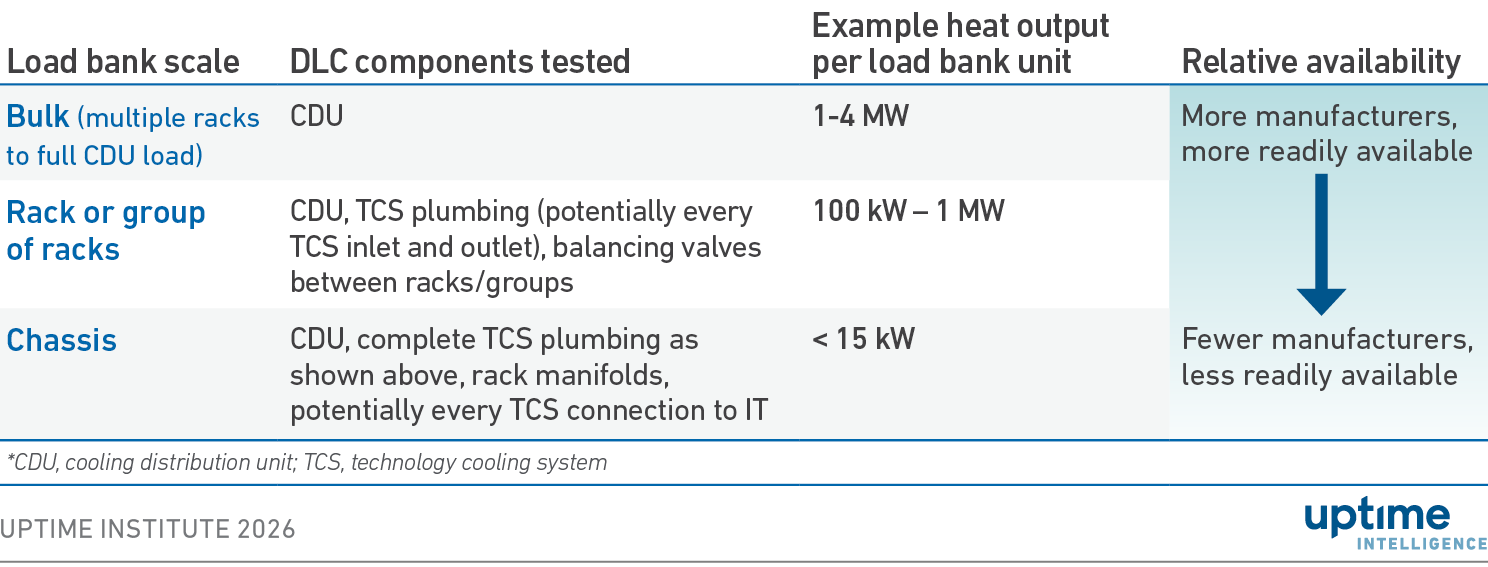
Liquid-cooled load banks are available across a variety of scales. Large, high-capacity load banks typically simulate the load of multiple IT racks in aggregate. Groups of smaller load banks are capable of more granular resolution, emulating the load behavior of individual IT racks or (less commonly) individual server chassis. This more granular system can also be installed on a more complete TCS loop and prove the performance of a larger set of components during the test. Table 1 details three major types of load banks by scale and typical capacity, as well as the DLC components they are capable of testing and their estimated availability.
Table 1 Types of liquid-cooled load banks
Load banks designed for connection to the SFN should closely simulate the following flow and thermal characteristics of the IT: heat load, coolant flow rate, temperature change (∆T), and pressure drop. The scale and resolution at which a load bank unit simulates these characteristics varies between manufacturers.
An integrated system test using large load banks can simulate these parameters for multiple IT racks in aggregate, using fewer load bank units. This test can take less time to implement but yields a lower-resolution view of system performance. More manufacturers offer this type of load bank, and relying on fewer units can save labor hours. However, some TCS components (e.g., balancing valves, sections of row manifolds, rack manifolds) that serve only one rack or group of racks will not be installed at the time of the test, so their performance will not be observed and documented.
Specifying rack- or chassis-scale load banks allows commissioning tests to potentially include every SFN inlet and outlet, balancing valves between racks or groups of racks, rack manifolds and, in some cases, the manifold inlet and outlet connections that will serve individual IT chassis. This commissioning approach provides a high-resolution, detailed view of system performance, but can require more time and expense. Additional SFN components and load bank units need to be installed for the test and flushed after it concludes. Also, load bank units that emulate IT behavior at the chassis level are relatively uncommon and offered by fewer manufacturers.
Some load banks for DLC commissioning simulate additional details of IT behavior. For example, some rack- or chassis-scale load banks include additional heater elements to simulate the IT load on the facility's air-cooling equipment. Even data halls hosting primarily cold-plate-cooled IT will include some air-cooling capacity, as cold plates capture most (about 70-95%, varying by cold plate and server design) but not all of the IT heat output. Additional server, storage and networking equipment may also be air cooled. The balance between the load bank's water-cooled and air-cooled heat output can typically be configured to meet the customer's requirements for each. IT air cooling systems should be included in the integrated system test, as in conventional commissioning — and operators may prefer to do so with these integrated load bank units instead of separate water-cooled and air-cooled load banks.
Some liquid-cooled load banks can also simulate variations in IT load over time. AI training clusters can produce large fluctuations in IT load in near unison, multiple times a second (see Electrical considerations with large AI compute). A few manufacturers offer rapid (for example, every 100 millisecond) power-switching capability in rack- and chassis-scale load banks. This is desirable for commissioning because it becomes possible to replicate the anticipated workloads' stresses on facility infrastructure more closely.
Rapid (millisecond) synchronized load fluctuations of AI clusters (or load banks that simulate them) pose a greater risk to data center and grid electrical distribution systems than they do to the data center's cooling systems. Slower synchronous load changes such as AI training checkpoints (occurring seconds apart) can require quick chiller or pump response but do not necessarily require commissioning with advanced load bank switching controls (see AI load and chiller systems: key considerations).
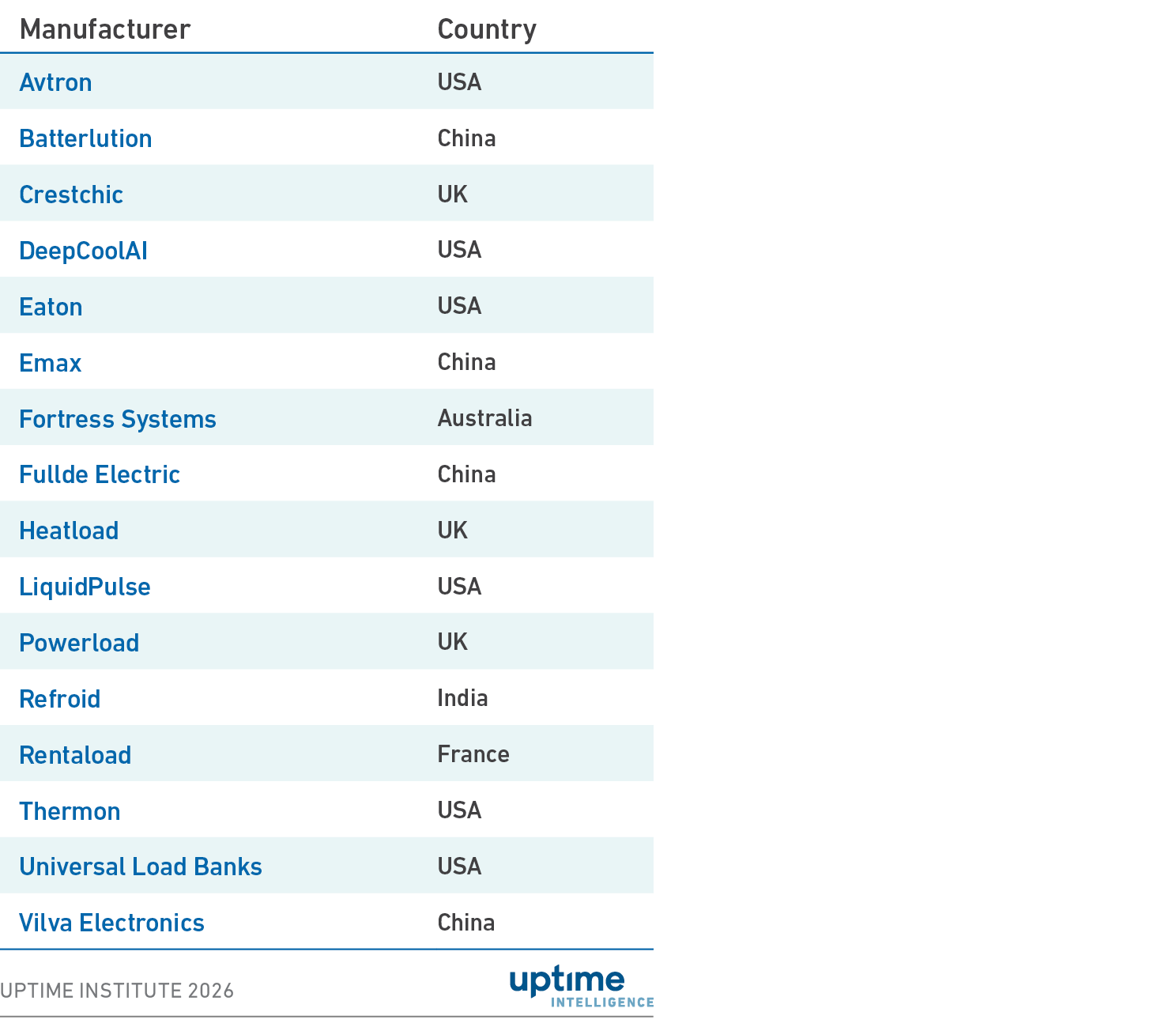
Table 2 lists manufacturers offering load banks for DLC commissioning in 2026 and the countries where they are headquartered. This list may not be exhaustive.
Table 2 Liquid-cooled load bank manufacturers
Operator commissioning expectations
In the years to come, more data center operators are likely to deploy DLC systems at scale. Many operators in the next generation of DLC adopters have developed tentative plans or pilot programs but have not yet moved into production. This is partly due to the complications that DLC introduces to resiliency design and commissioning procedures. These operators, especially those considering DLC for mission-critical workloads, are likely to insist on integrated system tests using liquid-cooled load banks. Their commissioning scripts will need to be adapted accordingly.
Still, the specifics of load bank form factor and test parameters will be subject to trade-offs between cost, speed, load bank availability and operator risk tolerance. More manufacturers may introduce rack- and chassis-scale load banks and rapid switching capabilities in response to operator demand.
The Uptime Intelligence View
During the early years of scale DLC deployment, a strong emphasis on the rapid production of trained AI models incentivized some hyperscalers to compromise on commissioning standards. DLC integrated system tests with liquid-cooled load banks were often limited in their ability to faithfully replicate IT behavior on TCS loops — if operators load-tested the TCS at all. In 2026, liquid-cooled load banks for DLC commissioning are beginning to mature as commercial products. Several manufacturers now offer these load banks, and they vary in form factor and testing capabilities. Operator preference will consider cost, speed, load bank availability and risk tolerance. In the coming years, operators will likely adopt increasingly thorough commissioning tests for DLC, especially where DLC supports mission-critical workloads.
Other related reports published by Uptime Institute include:
Coolant distribution units can complicate commissioning
AI load and chiller systems: key considerations
Electrical considerations with large AI compute
Validating the use of high-density DLC (case study)
AI facility developers advised to take a methodical approach
About the Author

Jacqueline Davis
Jacqueline is a Research Analyst at Uptime Institute covering global trends and technologies that underpin critical digital infrastructure. Her background includes environmental monitoring and data interpretation in the environmental compliance and health and safety fields.
jdavis@uptimeinstitute.com